
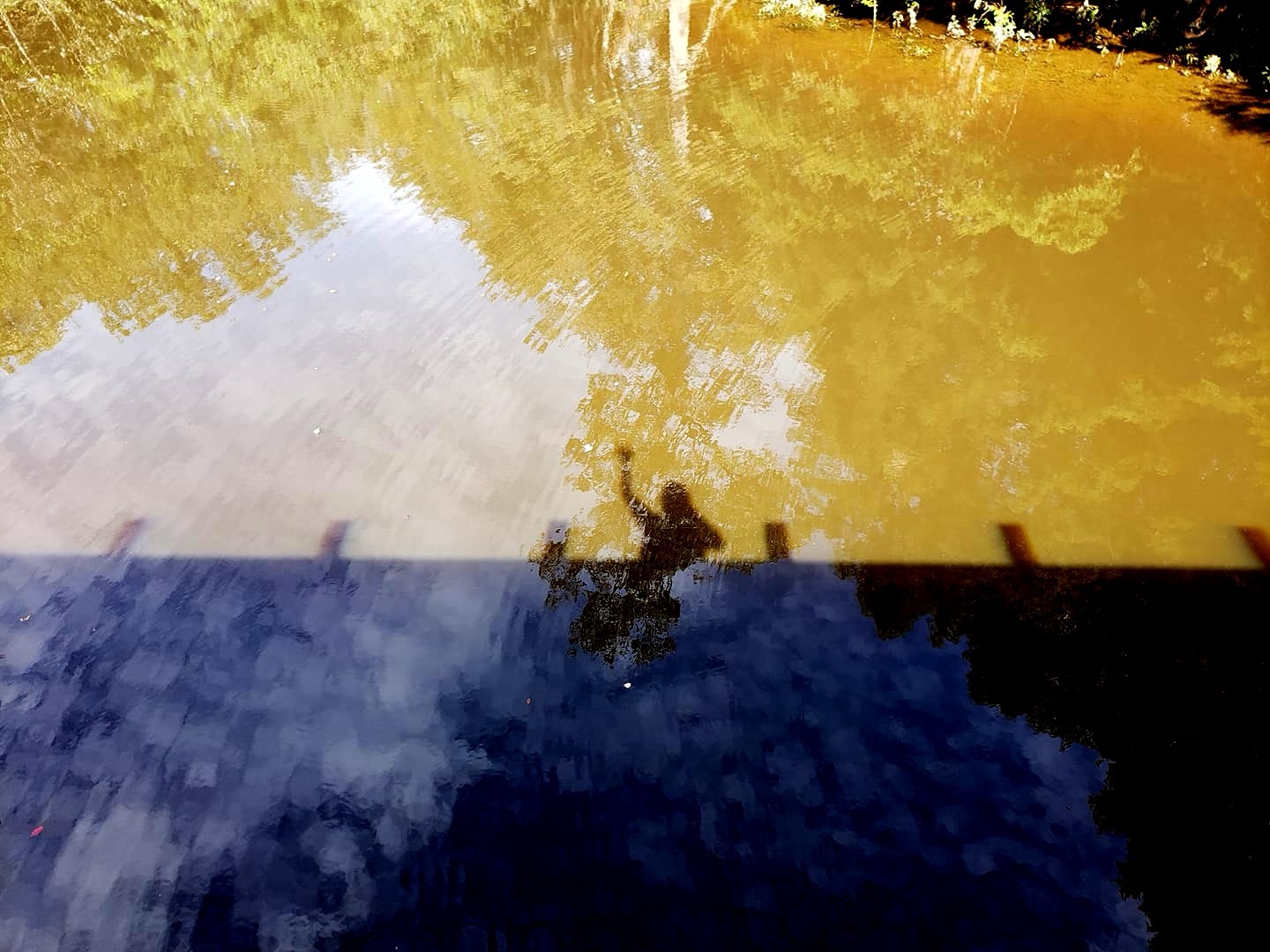
By Donny Screws
Few things are as beautiful as the morning mist over Gum Swamp in Bleckley County near Chicken Road.
Barred Owls cackle their hair-raising calls as other birds awaken and begin singing. The Swamp was alive all night long with the nocturnal beasts doing what they’ve done for millennia.
The beavers will startle you by slapping their tailson the water if you encounter them at midnight. I’ve seen big bobcats and coyotes as well as foxes, possums, racoons and recently even skunks have shown up in the Gum Swamp Watershed. Migrating Songbirds depend on it to power their journey north.
The Swamp is a living organism with many dimensions.
Walk through the Swamp and those Barred Owls will silently follow you, curiously staring with their big black eyes.
Parula Warblers and White Eyed Vireos sing while the big Kingfishers rattle loudly like an old engine.
Brown Water Snakes (Nerodia) rule the Swamp. Once I discovered that each evening around 7 pm a bunch of Browns climbed upon a fallen tree over the water each day to sun themselves.
I made plans and sat on that tree with my camera.
Eight big Brown Water Snakes joined me on that log. They were righteously suspicious of me, but as long as I was still, they tolerated me while basking in the warmth of the late afternoon sun.
Gum Swamp Creek defines our area here in Middle Georgia. It begins up in Twiggs just above Hwy 358, flowing past Danville & Cary, through the woods onward down to Cochran, crossing Hwy 26, a favorite fishing spot in the past. If you stopped by that bridge, you’d see Bowfin Skulls littering the banks there. Local fishermen call them “Blackfish” and tell stories of their tenacity.
The creek enlarges as it crosses the Chester Road near Oak Grove. Then it becomes even more beautiful near Chicken Road.
Vast farmland borders the creek there with old trees lining the banks. Bethel Bridge is an infamous spot there. Slab Lake is nearby in the woods. Things have happened here. History. Some stories can’t be told.
Flat Creek then joins, making it larger.
Recently, Google Maps began calling Flat “Little Gum Swamp.”
Flat Creek originates in Chester, where I played and collected samples for the microscopeas a kid. Planaria, Daphnia and Coepods lived there where a branch ran right through the middle of town.
Beavers and Snapping Turtles ventured into town as well. The section of Flat Creek where the Water Treatment Plant now sits was once a very thick, very dark Swamp.
Surrounding it were tall mounds of sawdust, remnants of the lumber industry that thrived here.
The tram that carried lumber from Roddy/Yonker/Empire later became a section of the Wrightsville-Tennile Railroad, which ran from here all the way up through Dublin.
Then turpentine was king. All that was cleared awayand is gone now, but you may still find railroad spikes. There were also artifacts there from past civilizations long before.
Walden Creek joins near Eastman and the Creek changes name there to Little Ocmulgee River. I’ve found arrowheads & artifacts by the dozens near all these Creeks.
Listening to Older Men talking about hunting & fishing down at Gum Swamp made It seem like a mysterious place to us growing up.
It is known for populations of Redfin Pike and “Jack” which are actually Pickerel. These long, large fish are voracious. If you put one in the aquarium it will make quick meals out of the other fish. “Pike and Blackfish” were the ones most caught.
There are structures in the swamp that are still a mystery. Some look like dams or bridges. Who built them? What were they used for?
Gum Swamp was once wider and deeper, a true small river. I heard stories of people swimming in the Creek, and folks like Bubba Moore told me they put in their boats on the Swamp on Chicken Road and cruised all the way to Eastman in the old days.
But forests were cleared and changed to Farmland. Tons of sediment and silt washed into the Creek making it narrower and shallower.
Today Gum Swamp sometimes appears to be a series of shallow mudholes, filled with runoff sediment. No more boating there until you get to Lumber City. Recently hundreds of acres were cleared and pecan trees were planted in the bare soil surrounding Gum Swamp.
One of the first churches in our area was built at Sandy Mount near Gum Swamp in mid to late 1800s – first church services before Chester was founded. I’ve never been able to locate Sandy Mount. It too remains a mystery.
Gum Swamp changes a good bit in the southern region, especially after Alligator Creek and Sugar Creek flow into it. Below Eastman it widens a bit and has more deep southern characteristics.
These two major creeks form a Devil’s Pitchforkon the maps where they join the Little Ocmulgee just above Lumber City.
There you can finally put in your boat, kayak or canoe. Huge Bryozoansfloat in the water there, looking like massive balls of jelly but they are actually colonies of tiny animals that filter and clean the water with tentacles, devouring algae and diatoms.
They also take in clay and silt, so the clarity of the water in which they live improves. They feel slimy to the touch and in south Gum Swamp/Little Ocmulgee, they get big. This is where we kayak the Stream.
Alligators also get big in these southern reaches, where the Creek joins the Ocmulgee River. This is near the Big Bend, where the Ocmulgee and Oconee Rivers join to form the mighty Altamaha.
Gators have been reported as far north as Eastman and a fairly large one was recently captured and relocated from a residential pond near Alligator Creek (of all places) on Middle Ground Church Road. I released an Alligator in Gum Swamp at Ocmulgee Church years ago.
Testing the Waters
Running through middle Georgia for millions of years, Gum Swamp was a major Native American Indian source of water, farming, and hunting areas.
Indigenous artifacts can be found all along Gum Swamp, and it is a major tributary of the Ocmulgee River, which then flows into the Altamaha River. Early European settlers built their homes and farms here, and for many years, Gum Swamp remained fairly wild and unaccessible, then was used for hunting and fishing.
To have a lot of fish and other creatures present, the smaller invertebrates must be numerous. Gum Swamp is known for having millions of freshwater shrimp, fairy shrimp, chimney crayfish, insects, and other invertebrates.
Gum Swamp Creek defines our area and for years, it defined our lives as we fish, swam, explored, hunted and lived here. It remains the major watershed of the Cochran/Chester/Roddy/Yonker/Plainfield area. Interestingly enough, this area is also where Tektites are found by the dozen.
The water in Gum Swamp is similar to other south Georgia coastal plain streams. The water is dark and stained with tannic acid from the tree leaves and other vegetation. Cypress trees abound in the areas surrounding Gum Swamp. Turkey and deer have been extremely numerous all along Gum Swamp, but with land clearing, their habitats are becoming smaller and more fragmented. This comes and goes as the years pass. There are actually a good many wild areas left there now. I hope that trend continues.
Tektites are impact glass from the massive collision of a large meteor in the Chesapeake Bay area 34.5 million years ago. They are sought after and collected all over the world as the best Tektites out there.
In recent years, Sherry Jones and her family, who own large tracts of land on the Creek have begun hosting the Annual ‘Gum Swamp Jam,’ a Party/Concert on the Banks of the Stream. It has grown to be a tradition in the rural areas surrounding Roddy, Yonker, Chester, and Cochran.
Currently the Gum Swamp Bridge in Yonker is being replaced by the Georgia DOT. You’ll have to take a detour, but locals know the dirt roads and where to go.
Every time we cross the Gum Swamp Bridges, no matter where we are, from above Cochran to Chicken Road, to Bethel Bridge to Chester Road to Eastman, Chauncey, McRae and down to Lumber City and the River, we do a little ritual honoring the Swamp. It brings life to our area and joy to our hearts. Gum Swamp remains an enigma.
The Mysteries of the Swamp may never be told.



Leave a Reply