

By Becky Holland
Today, I received an anonymous email containing serious allegations involving matters of public interest.
I’m not going to tell you what those allegations are.
Not yet.
That isn’t because I’m dismissing them. The email raises questions that I believe are worth asking.
But there is a difference between receiving information and being able to responsibly report it as fact.
I don’t know who sent the email. I don’t know that person’s relationship to the matters described, and I cannot independently establish from the email alone how the sender knows what he or she claims to know.
So I can’t responsibly publish the allegations as they were sent to me.
What I can do is report.
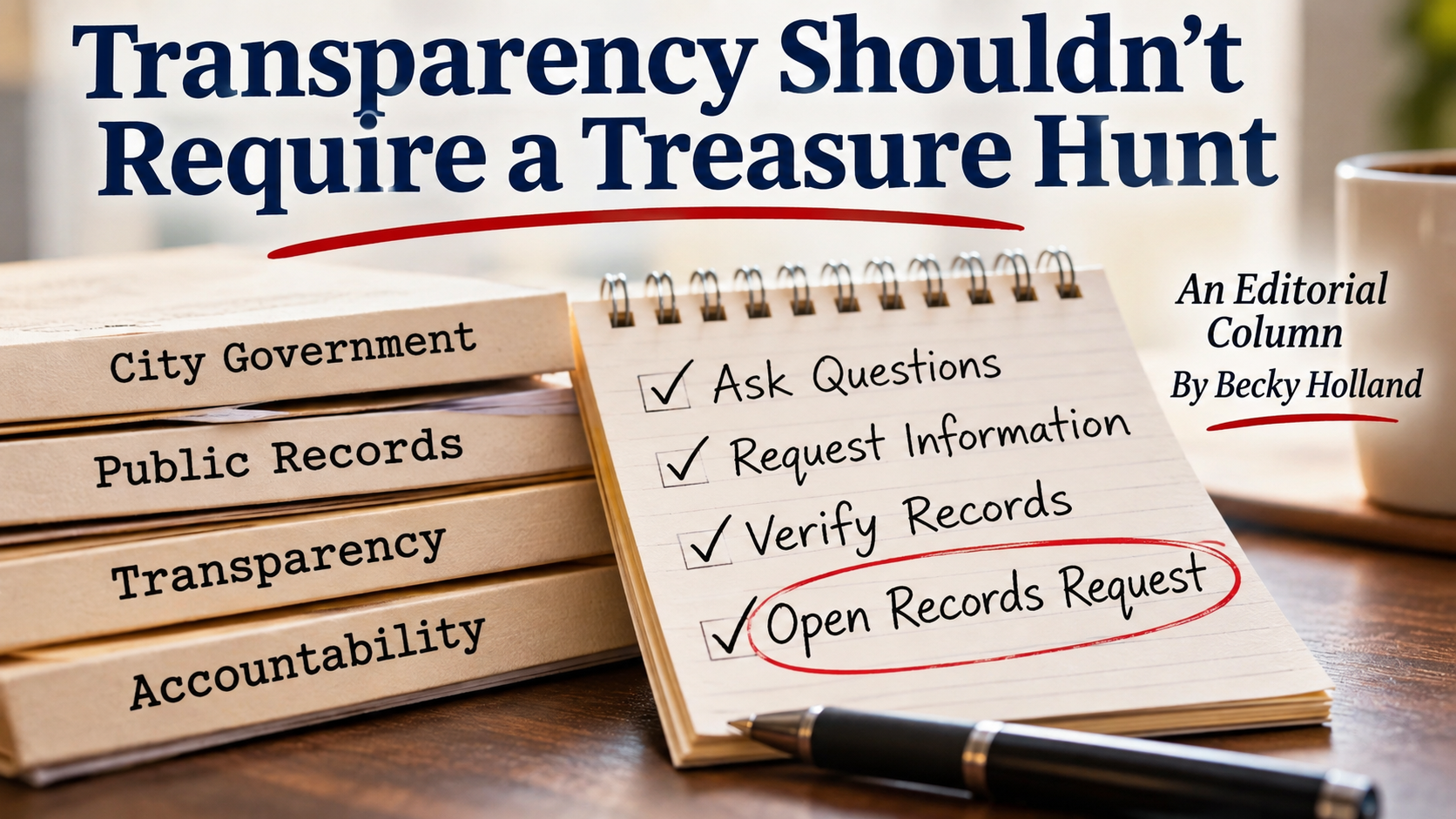
I can take the questions raised by that email and ask them through the proper channels. I can request public records. I can talk to people with firsthand knowledge. I can seek documentation. And I can give those involved an opportunity to respond.
If I can independently verify the facts, then I can report those facts to you.
That is an important distinction.
An anonymous tip can be valuable. It may point a journalist toward something that deserves examination. But a tip is not proof, and an allegation is not a fact simply because someone put it in an email.
There is also an important difference between an anonymous source and a confidential source.
A confidential source may tell me who they are, explain how they know something and provide information that allows me to evaluate their credibility. That person may have a legitimate reason for asking me not to publish their name.
I understand that.
People may worry about their jobs, their relationships or other consequences of speaking publicly. There are circumstances when protecting a source’s identity may be appropriate.
But the reporter still needs to know who the source is.
That is very different from receiving allegations from someone whose identity I do not know at all.
If you have information you believe The Ledger should investigate and you are concerned about having your name published, talk to me. We can discuss confidentiality before you provide information.
But I need enough information to do my job responsibly.
As for the anonymous email I received today, I’m not throwing it away.
I’m going to start asking questions.
I’ll look for records. I’ll seek verification. I’ll talk to people who may have firsthand knowledge. I’ll give people an opportunity to respond. And I’ll follow the facts wherever they lead.
A story does not cease to matter simply because the immediate problem goes away. If the facts are of legitimate public interest, the public deserves accurate reporting of those facts.
That principle matters to me.
My responsibility isn’t to produce a particular outcome. It isn’t to help one side win or another side lose. It is to ask questions, seek documentation, verify information and report what I can establish as accurately and fairly as possible.
Sometimes a tip becomes a story.
Sometimes the reporting shows that the tip was wrong.
Sometimes the truth turns out to be considerably more complicated than what arrived in the original email.
That’s why we report.
Because an anonymous tip can tell a reporter where to start looking.
It shouldn’t tell us where to stop.




Leave a Reply