
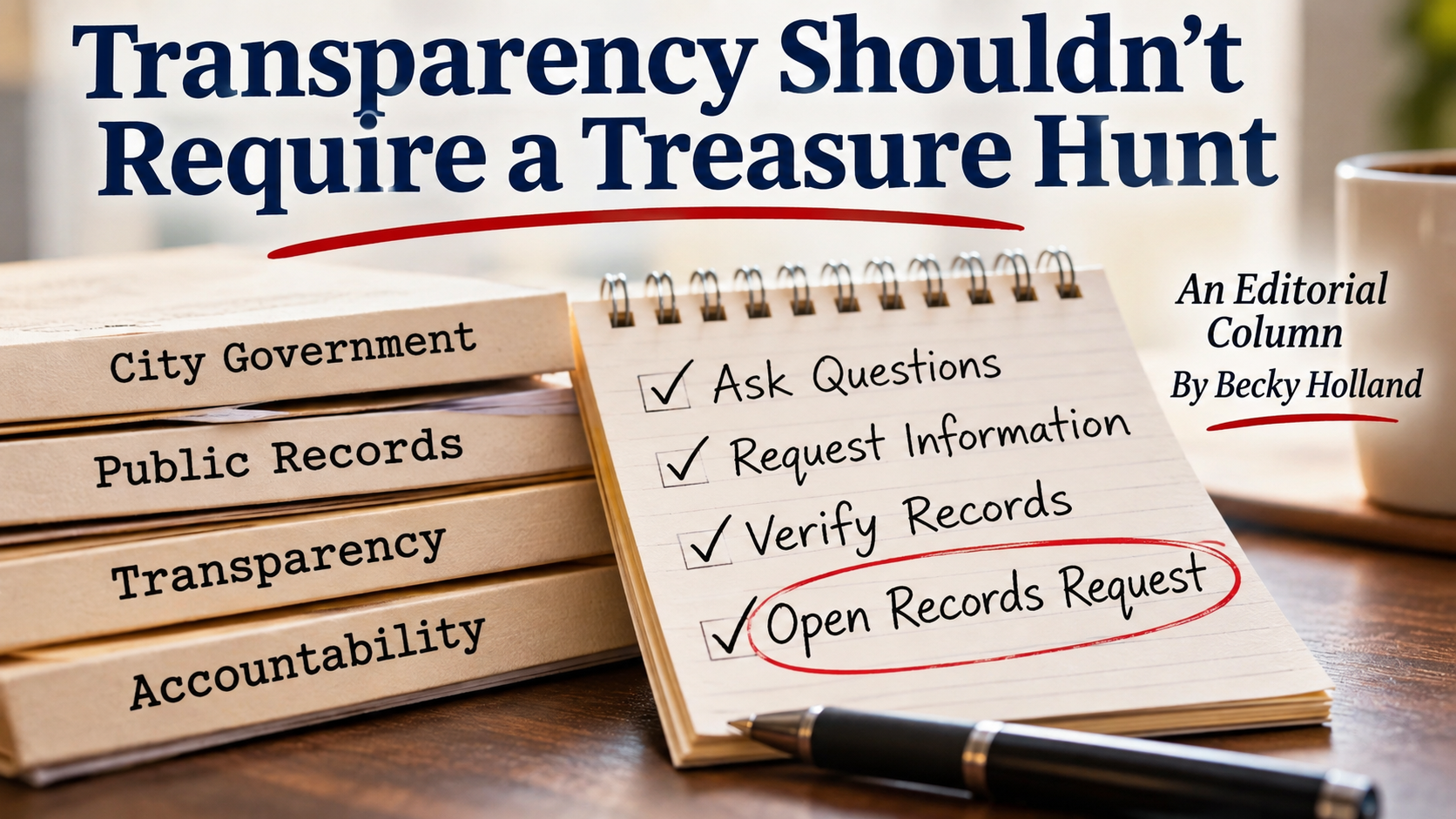
By Becky Holland
There’s a lot more to reporting the news than attending meetings, taking notes and writing stories.
Sometimes the real work begins after the meeting ends.
As a journalist, I frequently have questions that require additional information. Sometimes those questions are answered through a telephone conversation, an email exchange or a face-to-face interview. Other times, I request documents to verify information or provide a clearer picture for readers.
Most of the time, these are informal requests. I ask a question, someone provides an answer, and I continue working on the story.
That’s how the process should work.
But what happens when the answers don’t come?
Following city meetings last Thursday and Tuesday, I contacted Cochran City Manager Angela Redding and Mr. Hanes of Falcon Design regarding design and consulting services involving the city.
My questions were submitted informally. I did not file an official open records request because I believed a simple exchange of information would be sufficient. I requested responses by Monday, November 16.
However, another set of questions previously emailed to Redding remains unanswered. Whether the latest questions will receive responses remains to be seen.
That brings me to something readers should understand: the Georgia Open Records Act.
Under Georgia law, citizens and journalists have the right to request access to many records maintained by government agencies. These can include contracts, financial documents, salary information, meeting records and other materials involving the expenditure of public funds.
An open records request is not an accusation of wrongdoing. It is a legal means of obtaining information that belongs to the public.
Government agencies generally must respond within three business days of receiving a request. That does not necessarily mean every document must be produced within that period. If records cannot be provided within three business days, the agency must follow the law’s requirements concerning availability, timing and any applicable exemptions.
Earlier this evening, I submitted a formal open records request to the city clerk and Redding seeking salary information for the city manager, department heads, directors and supervisors, along with job descriptions for the city manager and city clerk.
I requested the information by Wednesday, November 18.
Why?
Because the public deserves context when its governing body discusses positions, responsibilities and salaries funded by taxpayers.
And what happens if the information isn’t provided?
With an informal interview request, there may be little more a reporter can do than follow up, document the lack of response and explain to readers what information could not be obtained.
A formal open records request is different. If an agency fails to comply with Georgia’s Open Records Act, there are avenues for pursuing compliance, including seeking assistance through the state’s open government resources or taking legal action when warranted.
But even when legal remedies exist, unanswered questions can delay reporting and leave the public without information needed to understand decisions being made on its behalf.
Let me be clear. I am not asking city officials to agree with my reporting, my questions or my opinions. I am asking for information.
The Ledger has a responsibility to report accurately and fairly. That means asking questions, verifying facts and giving those involved an opportunity to respond.
It also means acknowledging when information has been requested but not received.
Transparency should not depend on whether a question is convenient, comfortable or easy to answer.
Public officials serve the public. Public records exist for public accountability. And citizens should not have to navigate unnecessary obstacles to understand how their government operates.
I’ll continue asking questions.
And when the answers come, I’ll report them.
Because the public deserves more than unanswered questions.




Leave a Reply