
By Becky Holland
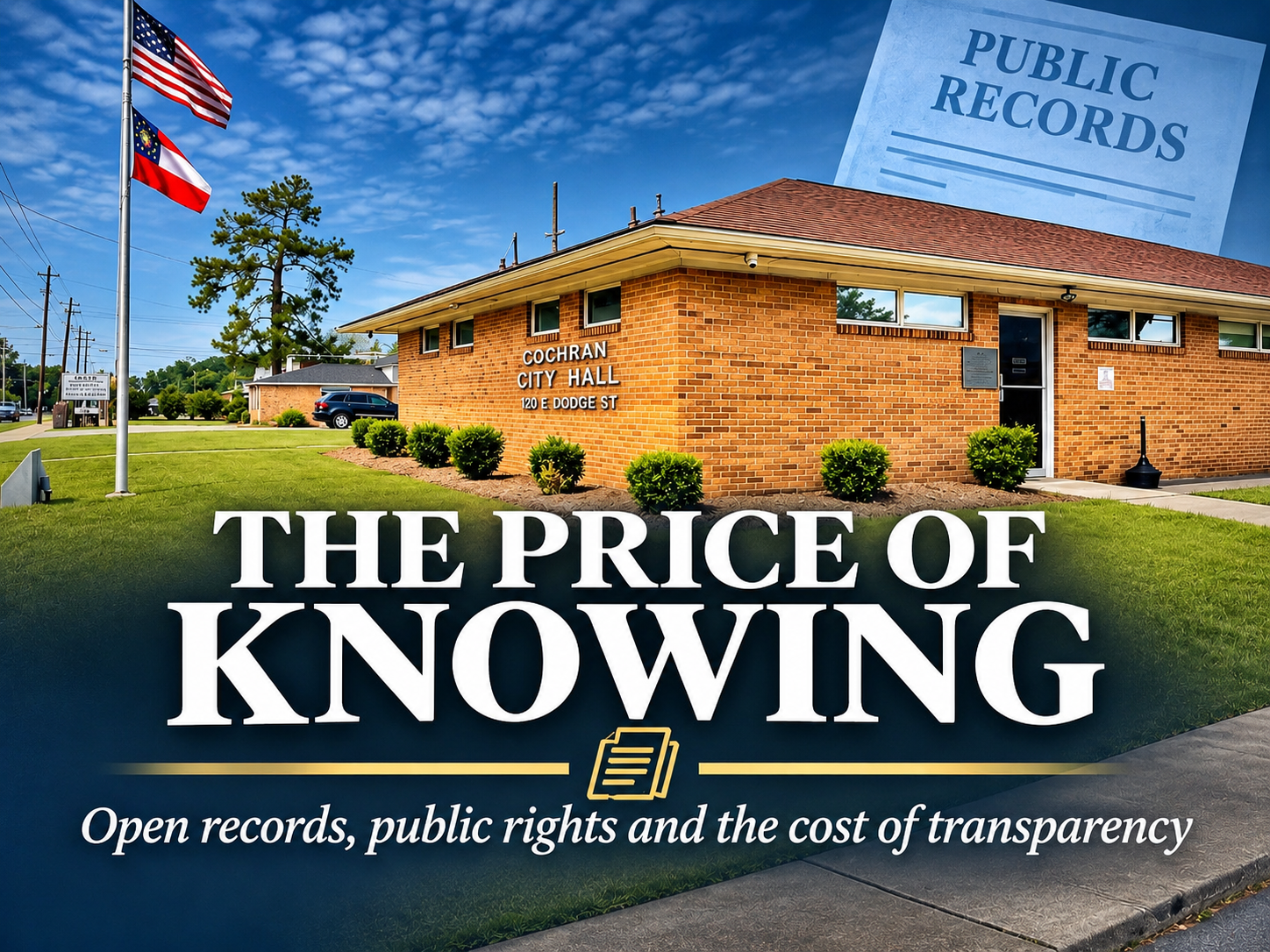
How much should it cost a citizen to find out what their government is doing?
It is a question worth asking, particularly when the government operates with money that comes from the very people requesting the information.
Throughout my more than 30 years in journalism, I have submitted numerous open records requests. Some have been fulfilled quickly and without charge. Others have required payment, additional correspondence and a considerable amount of patience.
But the Georgia Open Records Act is not something reserved exclusively for journalists. It is a tool available to ordinary citizens who want to know how their government operates, how their tax dollars are spent and how decisions affecting their community are made.
The Georgia General Assembly declares in O.C.G.A. § 50-18-70 that “open government is essential to a free, open, and democratic society.”
Those are not my words. Those are the words contained in Georgia law.
Government agencies are permitted to charge reasonable fees for searching, retrieving, redacting and producing public records. Nobody should expect an employee to spend hours gathering extensive documentation without recognizing the expense involved.
However, there are limitations.
Under O.C.G.A. § 50-18-71(c), agencies are directed to use the most economical means reasonably available to identify and produce responsive, nonexempt documents.
Personnel charges for searching, retrieving or redacting records generally cannot exceed the prorated hourly salary of the lowest-paid full-time employee with the necessary skills and training to fulfill the request. Additionally, no charge is to be made for the first 15 minutes.
Standard letter- and legal-sized copies generally cannot exceed 10 cents per page.
When anticipated costs exceed $25, the agency must provide an estimate and may delay the search until the requester agrees to the charges, subject to certain provisions. When estimated costs exceed $500, advance payment may be required. Previous unpaid records charges may also affect payment requirements.
There is a difference between agreeing to pay an estimated charge and paying that charge upfront.
The law also addresses response times. Records that can be located and produced within three business days generally should be made available within that period. When additional time is necessary, agencies must provide a description of the records and an anticipated timeline, with records made available as soon as practicable.
It is important to understand that requesting existing public records is different from asking government officials questions. The Open Records Act generally does not require officials to create new reports or answer questions.
Still, I believe answering reasonable questions from citizens should be part of good public service.
My concern is not that government agencies charge for legitimate expenses. My concern is what happens when the cost of obtaining information becomes a deterrent to the average citizen.
Not everyone can afford to spend $50, $75 or $100 to learn more about their local government.
Should financial circumstances determine how informed a citizen can be?
Government transparency should not be viewed as an inconvenience, and citizens seeking information should not be viewed as adversaries.
Asking questions is not an act of disrespect. It is an act of citizenship.
After all, an informed community is a stronger community.
And the public’s business should never become something the public cannot afford to understand.
Sources: Georgia Open Records Act, O.C.G.A. §§ 50-18-70 and 50-18-71; Office of the Governor of Georgia, Open Records Request guidance.





Leave a Reply