
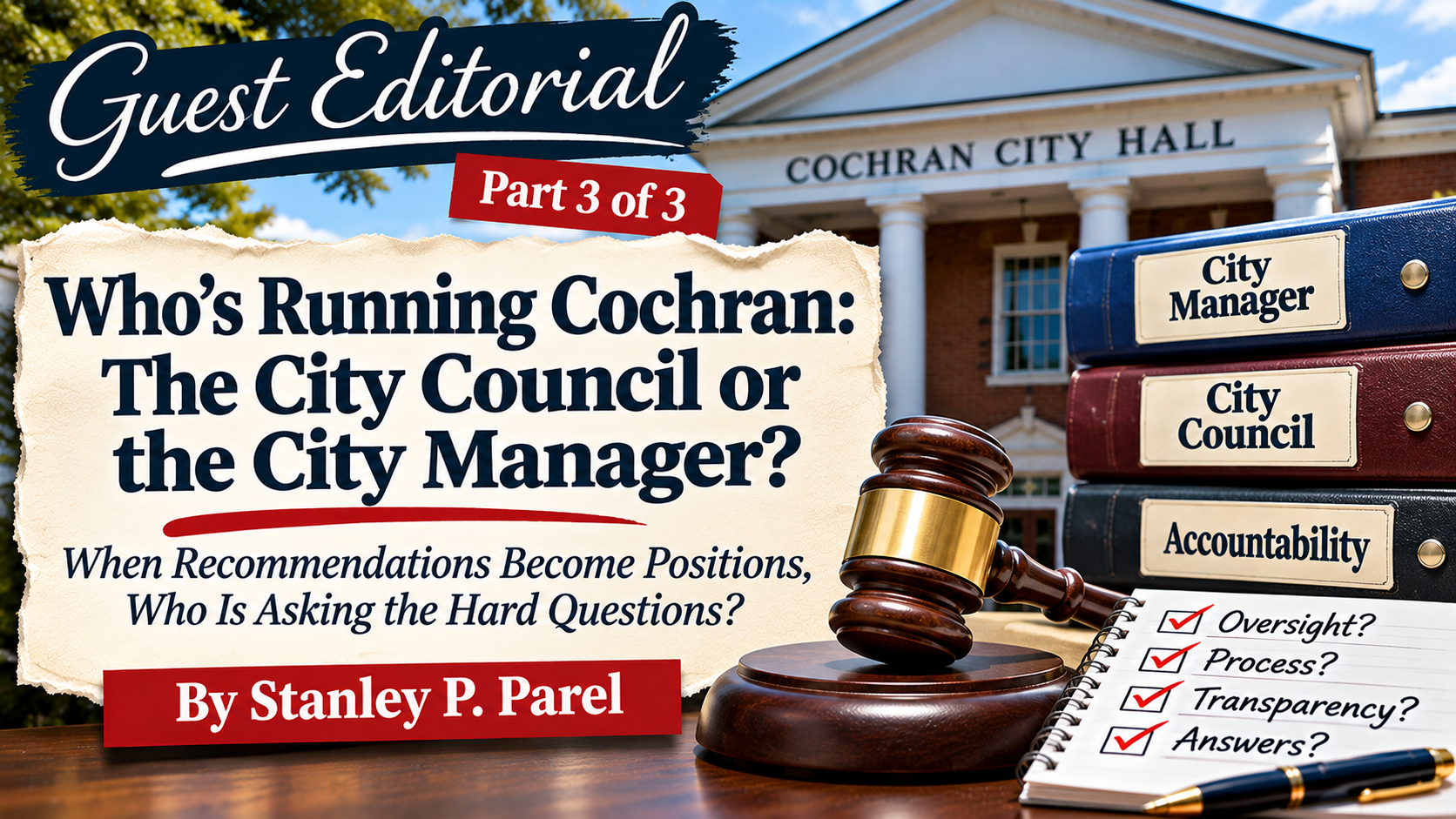
When Recommendations Become Positions, Who Is Asking the Hard Questions?
By Stanley P. Parel
Part Three of a Three-Part Series: Cochran City Hall — The Cost of Leadership
There is an old saying that government never seems to have enough money until it is time to expand government. Cochran may be giving that saying new life.
In the first two columns, I questioned the cost of two newly approved administrative positions and whether the council considered less expensive alternatives. But the larger issue is not simply the money. It is the process by which a small city decides to grow its government.
Are we establishing a precedent in which recommendations from a new city manager become permanent positions before the public sees a clear explanation of the need?
City managers should identify weaknesses, propose solutions, and recommend staffing changes. That is part of the job. Elected council members, however, must independently evaluate those proposals. A recommendation is not a command, and professional judgment does not replace public accountability.
Redding’s permanent appointment was approved before a finalized employment contract was in place. Now the council has supported two additional administrative positions while details of that contract are reportedly headed for discussion in December.
That sequence deserves scrutiny. It does not prove anyone acted improperly. It does suggest that the council should be especially careful to explain how major personnel decisions fit into a coherent plan.
At least one council member opposed the staffing proposal. That dissent matters. Was the objection primarily about cost, timing, structure, or something else? What evidence persuaded the majority that moving forward now was preferable to further review?
Was a formal staffing analysis completed? Did the council map responsibilities assigned to the city manager, city clerk, and existing administrative employees? Did it compare one combined position with two separate roles? Did it calculate the full long-term costs, including benefits and future salary increases?
And what happens when the next city manager arrives? Will these jobs remain necessary? Will additional positions eventually be requested to support them?
That is how administrative growth becomes a lasting obligation. A position created today may outlive the circumstances that supposedly justified it.
No one should expect the city manager to personally perform every specialized task. Planning and zoning require technical expertise, and human resources decisions carry legal and personnel risks. But a small city must be able to explain why its chosen staffing structure fits its size, workload, and budget.
The council may have sound answers. If so, publish the staffing rationale, projected total compensation, and alternatives considered. Let residents judge the reasoning rather than guess at it.
This is not an accusation against Angela Redding. It is a challenge to the City Council to demonstrate independent oversight and fiscal discipline.
The city manager recommends. The council decides. The taxpayers pay.
Cochran does not need a bigger government merely because bigger sounds better. It needs a smarter government.
And if the council cannot explain why two new positions are necessary, perhaps the first vacancy to address is the one where tougher questions ought to be asked.
Editor’s Note: This column is an opinion piece submitted by Stanley P. Parel. The views and opinions expressed are those of the author and do not necessarily reflect those of The Ledger, its publisher or its contributors. The Ledger welcomes thoughtful, respectful discussion of matters affecting our community.





Leave a Reply